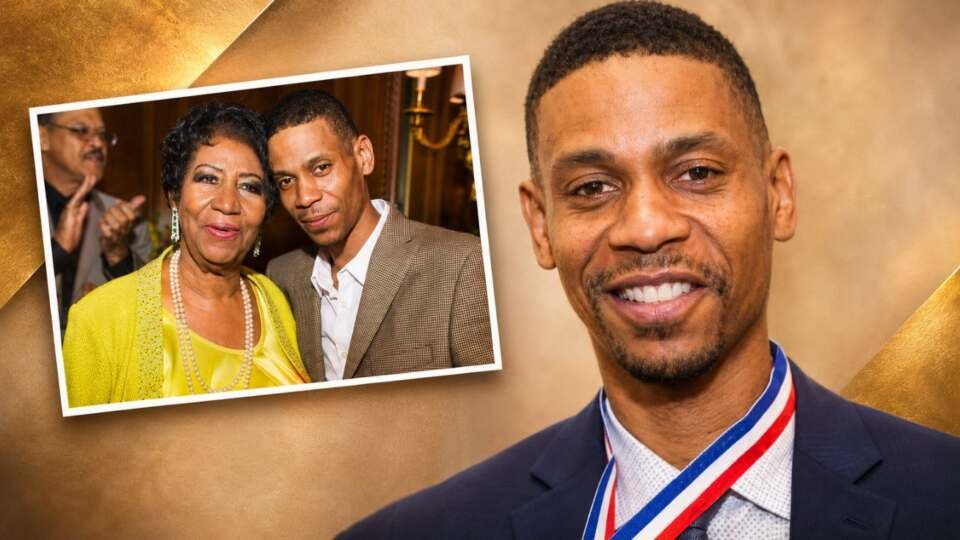
A handwritten will discovered beneath a sofa cushion changed the lives of Aretha Franklin’s children years after the Queen of Soul died. At the center of that legal dispute was her youngest son, Kecalf Cunningham, a Christian rapper whose life had previously attracted far less attention than his mother’s extraordinary career.
Also known as Kecalf Franklin, he has spent decades pursuing music on his own terms. His work includes gospel rap performances, a songwriting credit on one of Aretha’s albums, and more recent involvement in podcasting. Away from music, he is a husband and father whose children have developed their own creative interests.
The inheritance dispute brought another side of his life into public view. Questions about his family’s property, music royalties, and the preservation of Aretha’s recordings continued into 2026, making his story about much more than growing up with a famous parent.
Quick Facts
| Field | Details |
|---|---|
| Full Name | Kecalf Cunningham |
| Also Known As | Kecalf Franklin |
| Date of Birth | March 28, 1970 |
| Age in 2026 | 56 years |
| Nationality | American |
| Family Roots | Detroit, Michigan |
| Father | Ken Cunningham |
| Mother | Aretha Franklin |
| Older Brothers | Clarence, Edward, and Teddy |
| Wife | Kafi Franklin |
| Children | Six, including Jordan, Victorie, and Grace |
| Profession | Christian rapper and songwriter |
| Known Songwriting Credit | “New Day” (2011) |
The Story Behind His Name and Detroit Roots
Kecalf Cunningham was born on March 28, 1970, during one of the most successful periods of his mother’s career. His father, Ken Cunningham, worked as Aretha Franklin’s road manager and maintained a relationship with the singer after her marriage to Ted White ended. Although Ken and Aretha never married, they gave their son a name that connected both parents.
The spelling has a personal meaning. KEC comes from Ken E. Cunningham, while ALF represents Aretha Louise Franklin. The result, Kecalf, is pronounced approximately “Kelf.” Aretha herself explained the unusual name while discussing her youngest son’s interest in hip-hop during a 1995 interview.
Kecalf grew up with strong ties to Detroit, the city central to Aretha’s personal and musical history. The Franklin household was connected to church traditions, gospel singing, and the entertainment industry. His mother’s recordings were heard around the world, but her children also experienced the ordinary family responsibilities that existed beyond concerts and public appearances.
Growing Up With Three Older Brothers
Aretha Franklin had four sons, and Kecalf was the youngest. His brothers are Clarence Franklin, born in 1955; Edward Franklin, born in 1957; and Ted White Jr., born in 1964. Each experienced a different period of their mother’s life, which shaped their individual family relationships and eventual careers.
Edward developed an interest in gospel singing, while Ted became a guitarist and songwriter using the professional name Teddy Richards. Teddy also worked with his mother onstage. Clarence lived a more private life and received care through a legal guardianship arrangement.
These differences became particularly significant after Aretha’s death. Clarence did not participate in the 2023 will trial, while Kecalf and Edward supported one handwritten document and Teddy supported another. The family disagreement eventually moved from private discussions into a highly publicized Michigan courtroom.
Why Kecalf Cunningham Chose Christian Rap
Although he grew up surrounded by soul and gospel music, Kecalf did not attempt to become another traditional soul singer. Instead, he developed an interest in Christian hip-hop, combining rap delivery with religious themes and biblical storytelling.
His interest in rap was already established by the mid-1990s. During a 1995 interview, Aretha described her youngest son as a hip-hop performer and rapper, showing that his musical ambitions had developed long before the inheritance proceedings made his name familiar to wider audiences.
Kecalf has also used the performance identity KPoint. His musical style reflects the relationship between gospel traditions and contemporary rap, but his career has remained different from his mother’s mainstream success. He has focused on faith-centered performance, songwriting, and independent creative work rather than pursuing a conventional soul music career.
Aretha encouraged his interest in music. That support included sharing her concert stage with him, giving Kecalf an opportunity that many developing performers would never experience.
His Radio City Music Hall Performance and Songwriting Work
In March 2008, Kecalf appeared during an Aretha Franklin concert at Radio City Music Hall in New York City. Wearing a hoodie and carrying a backpack, he delivered a short Christian rap set backed by recorded tracks.
The performance received a critical response. His rap presentation contrasted sharply with Aretha’s commanding live vocals, and the interlude was considered one of the weaker moments of the concert. Even so, the performance demonstrated Aretha’s support for her son’s musical ambitions.
Kecalf later contributed to her recording career more directly. He co-wrote “New Day” with Norman West for Aretha’s 2011 album, A Woman Falling Out of Love. The song combined uplifting lyrics with contemporary gospel-pop production, providing a recognizable connection between his songwriting and his mother’s recorded music.
The track was produced by Brian Garrett and Joseph Hall. For Kecalf, the songwriting credit represented a different form of collaboration from performing at his mother’s concerts. It placed his name alongside established musicians within Aretha Franklin’s official recording catalog.
Wife Kafi Franklin and Their Six Children
Behind his musical career, Kecalf Cunningham is a husband and father. He is married to Kafi Franklin, and the couple have six children, including five daughters and one son.
Kafi has appeared alongside her husband during important family occasions, including the legal proceedings concerning Aretha’s estate. Their relationship became particularly visible following the July 2023 jury verdict, when relatives gathered to celebrate the court’s decision.
Several of their children have pursued artistic interests. Jordan Franklin, who performs under the name Jonah, has been involved in music production and recording. Victorie Franklin has explored singing, songwriting, and fashion, while Grace Franklin became familiar to television viewers through a national singing competition.
Grace auditioned for American Idol in February 2022, performing the Fugees’ version of “Killing Me Softly” before singing her grandmother’s “Ain’t No Way.” Although she did not advance, judges encouraged her to continue developing her voice.
The audition illustrated a challenge faced by younger members of the Franklin family: finding their own musical identities while carrying a celebrated surname. Grace emphasized that she wanted to be recognized for her individual voice rather than simply compared with her grandmother.
The Aretha Franklin He Knew at Home
Millions remember Aretha Franklin for her extraordinary voice, unforgettable performances, and recordings such as “Respect” and “Think.” Kecalf’s memories offer a different picture of the singer.
During an August 2019 family interview, he appeared with daughters Grace and Victorie to remember Aretha one year after her death. He spoke about relaxed family gatherings, including moments when everyone would sit together eating chicken wings.
His description of those ordinary occasions contrasted with the public image of a demanding music superstar. For her children and grandchildren, Aretha was also a mother and grandmother who enjoyed spending time with the people closest to her.
Kecalf accompanied her at public celebrations, including her 72nd birthday event in 2014. He was also present when Detroit dedicated Aretha Franklin Way in 2017, recognizing her influence on the city and American music.
Those appearances connected his private relationship with Aretha to the public celebrations of her achievements.
A Difficult Period After His Mother’s Death
Aretha Franklin died on August 16, 2018, at the age of 76. Her passing marked a major change for the family, bringing both personal grief and the responsibility of managing her extensive musical and financial affairs.
Kecalf also experienced a serious legal setback that year. He was arrested in Michigan on October 27, 2018, on an alcohol-related driving charge. Following court proceedings in December, he received a 93-day jail sentence after pleading to operating a motor vehicle while under the influence.
The case attracted attention because it occurred approximately two months after his mother’s death. It was separate from the estate proceedings that later became the family’s most prominent legal issue.
His public activities in subsequent years included family interviews, support for his children’s musical interests, and participation in the continuing debate over Aretha Franklin’s estate.
Why He Objected to Films About Aretha Franklin
Kecalf also became outspoken about how his mother’s life was portrayed on screen. In January 2020, he criticized the production of Respect, the biographical film starring Jennifer Hudson, because he believed Aretha’s children and grandchildren had not been sufficiently involved.
The dispute reflected broader disagreements over who should participate in telling the singer’s story. Family members and estate representatives did not always share the same position concerning the film projects developed after her death.
By 2021, Kecalf acknowledged efforts toward communication with the creators of Respect. However, his concerns continued regarding Genius: Aretha, the television drama starring Cynthia Erivo.
His daughter Grace Franklin publicly criticized that series through TikTok, arguing that the immediate family deserved greater involvement. Kecalf supported her position, emphasizing the importance of family memories when portraying someone whose private life differed from her stage persona.
The Handwritten Wills That Divided the Family
The most consequential legal dispute involving Kecalf concerned two handwritten wills discovered in Aretha Franklin’s home in 2019.
One document, dated June 2010, was kept inside a locked cabinet. A second, dated March 2014, appeared in a spiral notebook found beneath couch cushions. The later document contained handwritten changes and a signature featuring a small smiley face.
The differences mattered financially. The older document required Kecalf and Edward to complete business classes and earn a certificate or degree before benefiting from the estate. The newer document removed that condition and directed Aretha’s principal residence toward Kecalf and his children.
| Detail | 2010 Will | 2014 Will |
|---|---|---|
| Discovery | Locked cabinet | Notebook beneath couch cushions |
| Education Requirement | Required for Kecalf and Edward | Removed |
| Main Home | Different distribution instructions | Assigned to Kecalf and his children |
| Family Support | Teddy Richards | Kecalf and Edward |
| Court Outcome | Did not prevail | Declared valid in 2023 |
Aretha’s niece, Sabrina Owens, had initially managed the estate. As tensions increased, Kecalf sought a greater administrative role. Owens resigned in 2020, but disagreements over the documents continued.
On July 11, 2023, a Michigan jury determined that the 2014 handwritten document was a valid will. The decision was an important victory for Kecalf and Edward, who had argued that their mother’s later instructions should control the distribution of her property.
What Kecalf Cunningham Inherited and What It Means Financially
The most significant property decision followed in November 2023. Oakland County Probate Judge Jennifer Callaghan awarded Aretha Franklin’s principal Bloomfield Hills, Michigan, residence to Kecalf and his children.
The property had been valued at approximately $1.1 million when Aretha died in 2018. Its ownership became one of the clearest financial outcomes of the handwritten will dispute.
Other properties were distributed separately. Edward Franklin received another residence, while Teddy Richards was entitled to proceeds from a Detroit property that had already sold for approximately $300,000. Another property was designated for sale, with proceeds shared among the four sons.
The wider estate included more than real estate. Aretha’s recordings, compositions, royalty interests, personal possessions, and financial obligations all required management.
Those assets also carried substantial expenses. By 2023, estate records showed payments of at least $8.1 million to the Internal Revenue Service since 2020. Legal costs and ongoing administration created additional financial demands.
For anyone researching Kecalf Cunningham’s net worth, his inheritance is an important part of the picture, but it should not be confused with the total value of Aretha Franklin’s estate. The Bloomfield Hills property, possible royalty interests, and other family distributions involve different forms of ownership and income.
Why Aretha Franklin’s Estate Was Still in Court in 2026
The jury’s ruling did not settle every disagreement among Aretha Franklin’s heirs. By August 2026, the estate remained involved in probate proceedings over intellectual property, family expenses, legal fees, and items stored after the singer’s death.
Much of the continuing dispute involved Kecalf and Teddy Richards.
One issue concerned the distribution of copyright interests in recordings and songs such as “Think” and “Dr. Feelgood.” Another involved arrangements for their oldest brother Clarence, whose care needs remained an important family responsibility.
The estate also controlled hundreds of personal possessions kept in 11 storage units around metropolitan Detroit. These included vehicles, memorabilia, and materials connected to Aretha’s musical career.
Particularly valuable were reel-to-reel audio tapes and video recordings. Some audio reels carried little identifying information, meaning they could contain studio mixes, alternate performances, or unreleased recordings. The video collection included material associated with major concerts and television appearances.
Teddy Richards sought to move the recordings into storage better suited for preserving sensitive audio and video. He also objected to security cameras Kecalf was accused of installing at the storage facilities without consulting the other heirs.
Despite their disagreements, the brothers found common ground on certain decisions. They opposed some estate legal fees and cooperated in granting permission for the use of Aretha’s song “Think” in a 2024 political campaign advertisement.
The continuing case showed that validating a will was only one step in settling an estate containing valuable music rights, historical materials, and complicated family obligations.
His Podcast Work and Social Media Presence
Outside the courtroom, Kecalf has continued participating in conversations about music and family life.
On June 16, 2025, he appeared on the Wedding Weeds Podcast, hosted by Tracie Morris. The conversation covered Christian hip-hop, the role of music during weddings, personal celebrations, and Aretha Franklin’s thoughts on relationships.
He also discussed writing songs in different musical styles, including his contribution to “New Day.” The discussion highlighted aspects of his creative life that receive less attention than the estate litigation.
Kecalf has been associated with the Spotlight on Me podcast, which uses the Instagram handle @spotlightonmepodcast. His digital presence also includes the YouTube name Kecalf Franklin and the Facebook identity @EradesentViews.
These outlets offer a more personal view of his interests, ranging from music and entertainment to relationships and family experiences.
Frequently Asked Questions
How old is Kecalf Cunningham in 2026?
Kecalf Cunningham is 56 years old as of November 2026. He was born on March 28, 1970, and is Aretha Franklin’s youngest son.
Who is Kecalf Cunningham’s wife?
Kecalf is married to Kafi Franklin. They have six children together, including Jordan, Victorie, and Grace Franklin.
What is Kecalf Cunningham’s net worth?
His inheritance includes a Bloomfield Hills residence valued at $1.1 million in 2018, alongside interests connected to his mother’s estate.
Why did Kecalf Cunningham go to jail?
Kecalf received a 93-day jail sentence after an October 2018 DUI arrest and court proceedings involving alcohol-impaired driving.
What happened to Aretha Franklin’s estate in 2026?
The estate remained in probate proceedings, involving copyright rights, stored recordings, estate expenses, and disagreements among the heirs.
More Than the Queen of Soul’s Youngest Son
Kecalf Cunningham’s story is unusual because his personal career and family responsibilities have developed in the shadow of one of America’s greatest musical figures. He chose Christian hip-hop rather than traditional soul, contributed to his mother’s music, and watched younger members of the family begin finding their own artistic voices.
His inheritance brought substantial property interests, but it also placed him at the center of difficult decisions about Aretha Franklin’s recordings, possessions, and legacy. As the legal proceedings continued through 2026, the responsibilities associated with the Franklin name extended well beyond the original courtroom victory.
For Kecalf, the connection remains both professional and deeply personal. Behind the music rights, legal documents, and famous recordings is a family still working through the lasting consequences of losing its most celebrated member.
Do Read: Who Is Ilan Tobianah? Meet the French Lawyer Known as Zeus