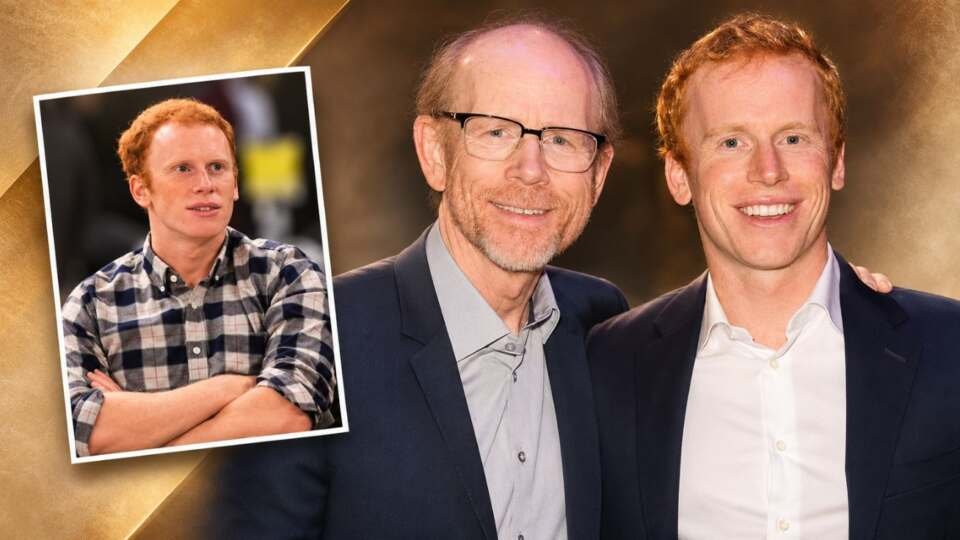
Reed Cross Howard, born on April 12, 1987, is an American professional golfer, golf instructor, and inventor best known as the youngest child and only son of filmmaker Ron Howard and author Cheryl Howard. While his older sister Bryce Dallas Howard built a career in Hollywood, Reed developed his skills on golf courses, competing in college tournaments and pursuing professional opportunities.
His sporting background includes qualifying for the 2008 U.S. Amateur Championship, competing on professional mini-tours, and developing a golf-training device called the Steadhead. He has also worked as a Titleist Performance Institute-certified trainer and contributed to instructional golf podcasts.
Now 39 years old, Reed combines a background in competitive golf with an interest in swing mechanics, fitness, and teaching. His personal life includes his wife, Ashley Howard, and their daughter, Aspen Leigh Howard.
Quick Facts
| Field | Details |
|---|---|
| Full Name | Reed Cross Howard |
| Date of Birth | April 12, 1987 |
| Age | 39 years old (2026) |
| Nationality | American |
| Height | 5 feet 10 inches (college roster) |
| Hometown | Banksville, New York |
| Parents | Ron Howard and Cheryl Howard |
| Siblings | Bryce Dallas Howard, Paige Carlyle Howard, Jocelyn Carlyle Howard |
| Profession | Professional golfer, instructor, and inventor |
| Education | Heritage Academy, Pepperdine University, USCB |
| Notable Achievement | Qualified for the 2008 U.S. Amateur Championship |
| Notable Invention | Steadhead golf training aid |
| Wife and Child | Ashley Howard; daughter Aspen Leigh Howard |
Early Life and Growing Up in the Howard Family
Reed was born into a family with deep connections to American entertainment. His father, Ron Howard, began acting as a child before becoming an Academy Award-winning director known for films such as Apollo 13, A Beautiful Mind, and Cinderella Man. His mother, Cheryl Howard, pursued writing and helped provide stability for their four children while Ron worked on demanding productions.
Although Hollywood was part of the family’s everyday experience, Reed spent much of his childhood in the Greenwich, Connecticut, area. Ron and Cheryl moved east during the 1980s because they wanted their children to experience a community beyond the entertainment industry. Reed’s later college records identified Banksville, New York, as his hometown.
This upbringing gave the Howard children opportunities to develop interests outside acting. Ron, who experienced the challenges of childhood fame firsthand, was particularly cautious about allowing his children to begin professional acting at an early age. Their household emphasized education, family relationships, and the freedom to pursue individual interests.
Reed grew up with three older sisters. Bryce Dallas Howard, born in 1981, became an accomplished actress and director, appearing in films such as The Help and Jurassic World. His twin sisters, Paige Carlyle Howard and Jocelyn Carlyle Howard, were born in 1985. Paige pursued acting and writing, while Jocelyn chose a more private life.
The siblings also share an unusual naming tradition. Their middle names reflect places associated with their parents’ family history and conception stories. Dallas refers to the Texas city, Carlyle connects to a New York hotel, and Reed’s middle name, Cross, refers to a London street where the family once lived.
That detail offers a personal glimpse into the Howard family’s sense of humor. Rather than choosing conventional middle names, Ron and Cheryl gave their children names connected to meaningful locations in their lives.
From Junior Golf to Pepperdine and USCB
Golf became an important part of Reed’s life during his teenage years. He attended Heritage Academy on Hilton Head Island, South Carolina, an institution designed to support student athletes and performers who need flexible academic schedules. Its connections with specialized athletic training programs made it a suitable environment for students pursuing competitive sports.
His early golf achievements were already substantial before college. Between 2003 and 2005, Reed recorded 15 top-three finishes on the International Junior Golf Tour. He also qualified for a Hooters Tour event during the summer of 2005, gaining experience against a more advanced competitive field.
Those performances helped him earn a place in the Pepperdine University men’s golf program. Pepperdine recruited him as a freshman in 2005, recognizing the results he had achieved in junior tournaments. He later continued his academic and athletic career at the University of South Carolina Beaufort (USCB).
At USCB, Reed became a member of the university’s first men’s golf team during the 2007–08 academic year. Joining an inaugural program gave him the opportunity to contribute to the early competitive history of the Sand Sharks. He pursued history as his academic major while representing the university in collegiate tournaments.
His fall 2008 statistics provide a detailed picture of his performance. Across 16 rounds, he recorded 1,197 strokes, producing a 74.8 scoring average. At the USC Aiken Invitational, he opened with a round of 70, followed by 73, for a two-round total of 143.
Other tournament results included a 219 at the Webber International Tournament, a 223 at the Wilmington Island Invitational, and a 150 over two rounds at the J. Lindeberg Sand Shark Classic.
These figures show that Reed was an established collegiate competitor rather than simply a recreational golfer. His results also provide a useful foundation for understanding the professional ambitions he pursued after college.
His 2008 U.S. Amateur Championship Experience
One of Reed’s most notable sporting achievements came in 2008, when he qualified for the 108th U.S. Amateur Championship at Pinehurst Resort in North Carolina. Qualification was a significant accomplishment because the championship attracted thousands of entrants seeking places in one of American amateur golf’s leading competitions.
The 2008 championship received 7,298 entries, with the tournament played across Pinehurst’s No. 2 and No. 4 courses. The event brought together accomplished college golfers, elite amateurs, and several competitors who would later establish successful professional careers.
Reed completed the opening stroke-play competition with rounds of 74 and 75, finishing on 149 strokes. That total placed him four strokes beyond the score required to advance into the match-play stage, where the leading 64 players continued competing for the championship.
The tournament was eventually won by Danny Lee, who defeated Drew Kittleson in the final. Other notable participants included Rickie Fowler, Billy Horschel, and Patrick Reed, illustrating the strength of the championship field.
For Reed, reaching Pinehurst represented an important competitive milestone. His participation demonstrated that he could qualify for a national championship and compete against talented golfers from across the United States and beyond.
Professional Mini-Tour Golf and the Single-Plane Swing
After his college years, Reed continued pursuing professional golf through developmental mini-tour competition. These smaller circuits offer aspiring professionals tournament experience outside the major tours, often requiring players to manage travel, entry fees, practice schedules, and competition expenses independently.
A particularly revealing part of his career emerged in October 2017, when he described his efforts to reconstruct his golf swing. He had spent several years studying the single-plane swing, a method closely associated with Canadian golfer Moe Norman, whose exceptional ball-striking consistency earned widespread admiration.
In a conventional golf swing, the club may move through different angles during the backswing and downswing. A single-plane approach seeks a more consistent relationship between the lead arm, club shaft, and impact position. The goal is to simplify certain movements and make delivering the club to the ball more repeatable.
Reed became interested in this technique because of its potential to improve his ball striking. After several years of experimentation, he began working with golf instructor Todd Graves, who specializes in teaching principles associated with Moe Norman’s swing.
Reed Howard explores single-plane golf swing techniques and shares practical tips for improving swing consistency and ball striking.
The transition required significant technical adjustments. Reed worked on his address position, backswing, body movement, and club delivery. By late 2017, after approximately 18 months of instruction, he considered his reconstructed swing functional and described making roughly half his recent tournament cuts.
His competitive ambitions continued into 2018. He planned to play primarily on the Golden State Tour, a professional mini-tour circuit in the western United States, while preparing for opportunities to advance through qualifying competitions.
This period helps explain the years between Reed’s college achievements and his later instructional work. His practical experience with swing changes, tournament preparation, and inconsistent ball striking became valuable subjects for the coaching and training content he subsequently developed.
The Steadhead Invention and TPI Golf Training
Reed’s interest in swing mechanics eventually led him to create the Steadhead, a golf-training device designed to help players monitor excessive head movement. The invention grew from a problem he noticed in his own swing: his head was moving downward and backward during the downswing, affecting his ability to deliver the club consistently.
The Steadhead uses a relatively simple design. A clip attaches to the brim of a golfer’s cap, supporting a small visual reference positioned within the player’s peripheral vision. While focusing on the ball, the golfer can use that reference to recognize unwanted head movement during the swing.
This concept addresses a familiar problem for recreational players. Excessive swaying, lifting, or dropping of the head can make it harder to control the club’s movement through impact. Inconsistent movement may also contribute to poor contact, including shots struck too heavily into the turf or too thinly across the ball.
The purpose is not to make the golfer completely motionless. Natural body rotation remains essential to an effective swing. Instead, the device encourages players to recognize excessive movement and develop a more consistent relationship between their body position and the ball.
Alongside his invention, Reed expanded his knowledge through the Titleist Performance Institute (TPI). He has been identified as a TPI-certified trainer, connecting his golf instruction to the physical demands of the sport.
TPI’s training philosophy examines the relationship between a player’s physical abilities and golf-swing mechanics. This includes evaluating hip mobility, thoracic spine rotation, stability, strength, and movement patterns that may influence performance.
For example, limited hip rotation can affect how a golfer turns during the swing. Restrictions in upper-body mobility may also influence posture, club delivery, and overall coordination. Understanding these relationships helps instructors distinguish between mechanical habits and physical limitations.
Reed’s background in competitive golf, technical experimentation, and fitness training gives his instructional work a practical foundation. His experience demonstrates how studying the mechanics of a sport can lead to useful products and teaching methods.
Golf Podcasts and Practical Advice for Amateur Players
Reed also became involved in golf media, sharing technical and strategic advice with recreational players. In 2022, he co-hosted the Play Smart podcast with golf editor Luke Kerr-Dineen. Their discussions explored common mistakes, swing mechanics, course management, and practical ways to improve scoring.
Course Management and Shot Selection
One of Reed’s recurring recommendations concerned choosing safer targets. Rather than automatically aiming at the center of a fairway, golfers should consider hazards on both sides and identify the most favorable landing area. A sensible target often reduces risk more effectively than attempting a perfect shot.
He also encouraged players to develop a predictable shot shape. Whether a golfer naturally hits a draw or a fade, understanding the usual direction and amount of curvature makes it easier to plan shots around hazards.
Improving Iron Distance and Ball Striking
Another important lesson involved iron distances. Amateur golfers frequently select clubs based on the longest shot they remember hitting instead of their typical carry distance. Reed suggested tracking where approach shots actually land and measuring how far short or long they finish.
For instance, if an 8-iron lands 10 yards short of a target positioned 150 yards away, the player can begin recognizing that the shot carried closer to 140 yards. Recording these distances can improve club selection without requiring expensive launch-monitor equipment.
His instruction also emphasized the value of consistent ball striking and keeping tee shots in play. Golfers with limited practice time can often benefit from improving full-swing contact rather than concentrating exclusively on difficult short-game shots.
Golf IQ Podcast and Short-Game Tips
In 2023, Reed continued contributing to instructional conversations through the Golf IQ podcast. The shorter episodes addressed mistakes that regularly cost amateur players strokes, including poor course strategy, distance judgment, and unnecessary complexity around the greens.
During discussions about chipping, he recommended developing a reliable, relatively low-trajectory greenside shot rather than relying on difficult high-lofted shots in ordinary situations. One example involved a chip designed to travel approximately 20 feet through the air before rolling another 10 feet.
The central theme of his teaching is practical decision-making. Better scores depend not only on producing technically sound swings but also on understanding distances, managing misses, and selecting shots that suit a player’s abilities.
Marriage, Family Life, and His Television Appearance
Away from golf, Reed is a husband and father. He married Ashley Howard in 2015, an occasion that his father celebrated as an important family milestone. Ron has frequently expressed how meaningful it is to see his children develop their own relationships, careers, and personal achievements.
Reed and Ashley welcomed their daughter, Aspen Leigh Howard, in 2019. That June, Ron celebrated Reed’s first Father’s Day by sharing a family photograph of his son feeding his baby daughter. The moment offered a personal glimpse into Reed’s life beyond professional sports.
Despite choosing golf as his main career, Reed has made an appearance connected to his family’s entertainment background. In 2018, he appeared as himself in the television comedy Arrested Development, during the sixth episode of its fifth season, titled Emotional Baggage.
The episode included several members of the Howard family, creating a humorous crossover between the show’s fictional world and Ron Howard’s real relatives. Reed appeared alongside family members rather than pursuing a separate acting role.
His personal story therefore includes connections to Hollywood without being defined entirely by it. His marriage, fatherhood, sporting achievements, and instructional projects form the most recognizable parts of his adult life.
Social Media and Online Golf Presence
Reed Cross Howard has shared aspects of his sporting and personal life through Instagram and YouTube. His Instagram presence has been associated with the handle @reedchoward, featuring golf practice, fitness activities, and family photographs. His instructional videos have also appeared under the name Reed Howard Golf on YouTube.
His online content reflects the same interests seen throughout his competitive and coaching career. Swing demonstrations, practice techniques, and golf-related discussions offer followers insight into his approach to improvement. His podcast appearances have also extended his reach to players seeking practical guidance.
Five Interesting Facts About Reed Cross Howard
- He had an impressive junior golf record. Between 2003 and 2005, he achieved 15 top-three finishes on the International Junior Golf Tour.
- He competed at Pinehurst against future professionals. The 2008 U.S. Amateur featured players who later became familiar names on professional golf tours.
- He spent years rebuilding his swing. His work with Todd Graves followed several years of personal experimentation with single-plane swing mechanics.
- His invention began with his own practice problem. The Steadhead was created after he recognized excessive head movement affecting his ball striking.
- His family appeared together in a television comedy. Reed joined several relatives in the 2018 Arrested Development episode “Emotional Baggage.”
FAQs
Why did Reed Cross Howard pursue golf instead of acting?
Reed developed his career through junior tournaments, college golf, and professional mini-tours, later expanding into golf instruction.
What is the Steadhead golf training aid?
The Steadhead is Reed Howard’s cap-mounted training device, designed to help golfers recognize excessive head movement during a swing.
Did Reed Cross Howard compete in the U.S. Amateur?
Yes. He qualified for the 2008 U.S. Amateur at Pinehurst, recording rounds of 74 and 75 for a two-round total of 149.
What is the meaning of Reed Howard’s middle name?
His middle name, Cross, comes from a street in London where the Howard family lived, continuing their location-inspired naming tradition.
Who is Reed Cross Howard’s wife?
Reed married Ashley Howard in 2015. The couple welcomed their daughter, Aspen Leigh Howard, in 2019.
Conclusion
Reed Cross Howard has built a distinctive career around golf, combining competitive experience with technical instruction and product development. His college performances, appearance at the 2008 U.S. Amateur Championship, professional mini-tour ambitions, and creation of the Steadhead illustrate his commitment to understanding and improving the game.
At 39 years old in 2026, Reed is also part of a close-knit family that includes his wife Ashley and daughter Aspen Leigh. Although his connection to Ron Howard attracts attention, his sporting achievements and instructional work give readers a fuller understanding of his personal and professional identity.
Do Read: Boogie Tillmon Biography: Life After Divorce From Trey Parker